



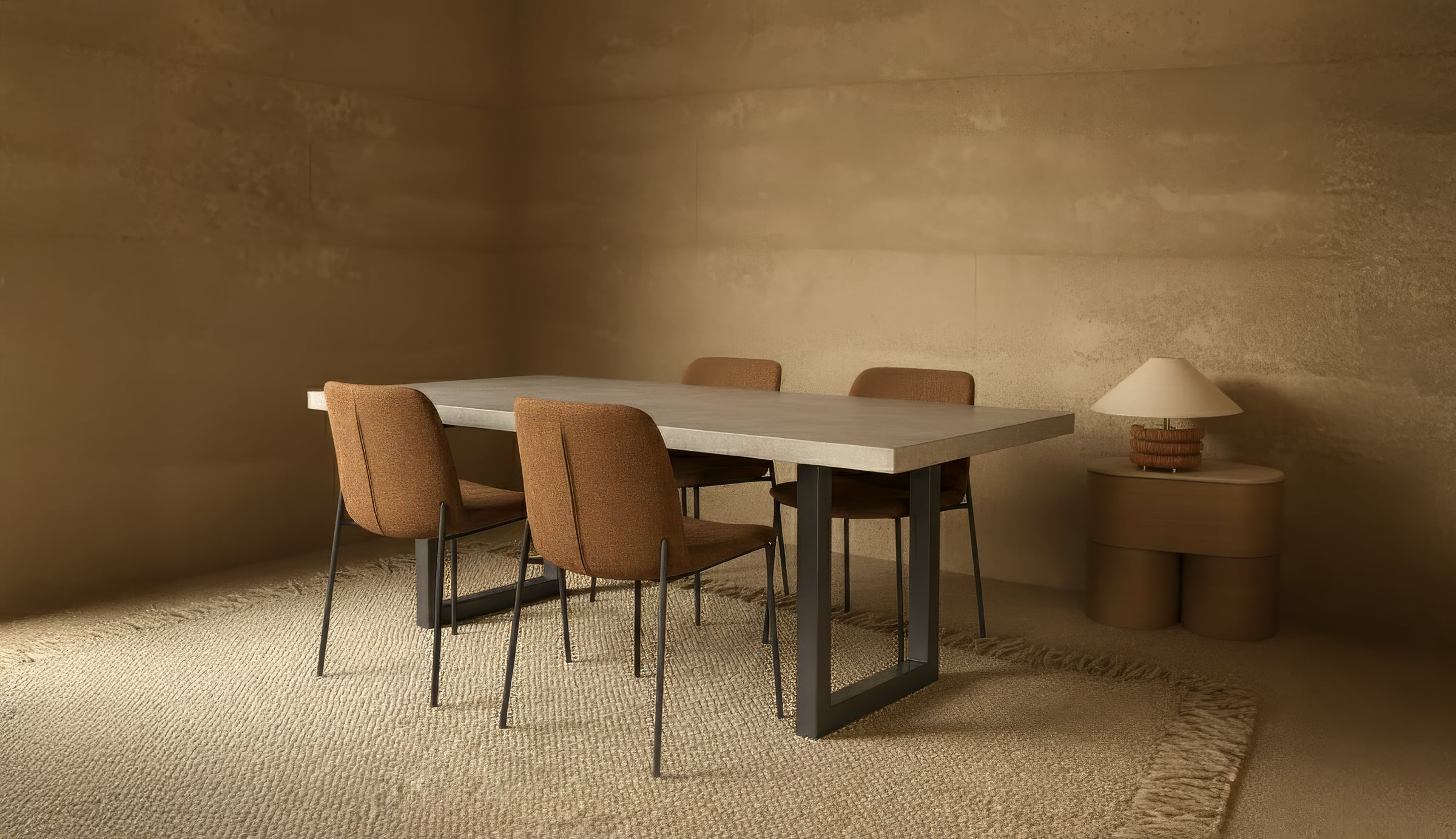
Concrete and marble both read architectural; both anchor a room. They're often briefed interchangeably, then specified differently because the trade-offs reveal themselves under use. Here's the honest comparison from a Melbourne studio that casts the concrete and respects the marble.
Durability under use
Marble is hard but porous and acid-sensitive. A spilled glass of red wine, a split lemon, or a careless splash of vinaigrette can etch the surface in minutes. The damage is visible and permanent unless the slab is honed back. Most marble dining tables sit under nervous owners and a constant rotation of coasters.
Architectural concrete, specifically the silica-free, glass-fibre reinforced composition we use, is sealed at finish with a satin food-safe seal that resists red wine for six hours. The concrete underneath is essentially indestructible by household standards.
Weight and proportion
Solid marble of comparable size weighs roughly twice what an architectural concrete table weighs. Our composition runs about a third the weight of traditional concrete, because we replace the aggregate and steel with high-performance polymers and glass fibre reinforcement. We give the exact weight for your piece on the quote.
Marble's weight matters at delivery and at any future move. Concrete is heavy — not light — but it's a weight the studio's freight vehicle handles solo and that two people can position in a room. Marble usually wants four people and a hand-truck.
Finish and pattern
Marble is a found pattern. The veining is what you're paying for — you can't specify it; you can only choose between the slabs the quarry sent. That's a feature for some clients and a frustration for others.
Concrete is a designed pattern. We batch the pigment to your specification, choose the aggregate, control the polish, and cast a sample tile for sign-off before the main pour. If you want the calm of a uniform surface or the depth of a specific colour, concrete delivers it. If you want a one-of-a-kind veining, marble delivers that.
Repairability
An etched marble surface returns to specification only by re-honing the entire slab. That's a stonemason job, not a DIY task, and it shortens the slab fractionally each time.
A worn concrete seal returns to specification by re-applying the seal — we offer a studio re-seal service for pieces five years and older. The underlying composition is unchanged. Edge chips repair with a colour-matched compound; major damage returns to the studio for invisible re-finishing.
Cost
A premium marble dining table from an established Melbourne stonemason runs $7,000 to $15,000 depending on size, edge profile, and slab. Architectural concrete in our range runs $3,500 to $8,000 for comparable sizes. The price gap reflects the materials and the labour, not a quality gap; both deliver pieces that last a generation.
Which one suits which room?
Marble suits formal dining rooms with low daily use and clients who welcome the patina of etching. Cool palettes and classical interiors are natural settings.
Concrete suits everyday-used rooms — family kitchens, open-plan living, outdoor settings — and clients who want a calm, designed surface that takes daily life without flinching. It also suits clients who want a specific colour, since pigment is a choice rather than a draw.