



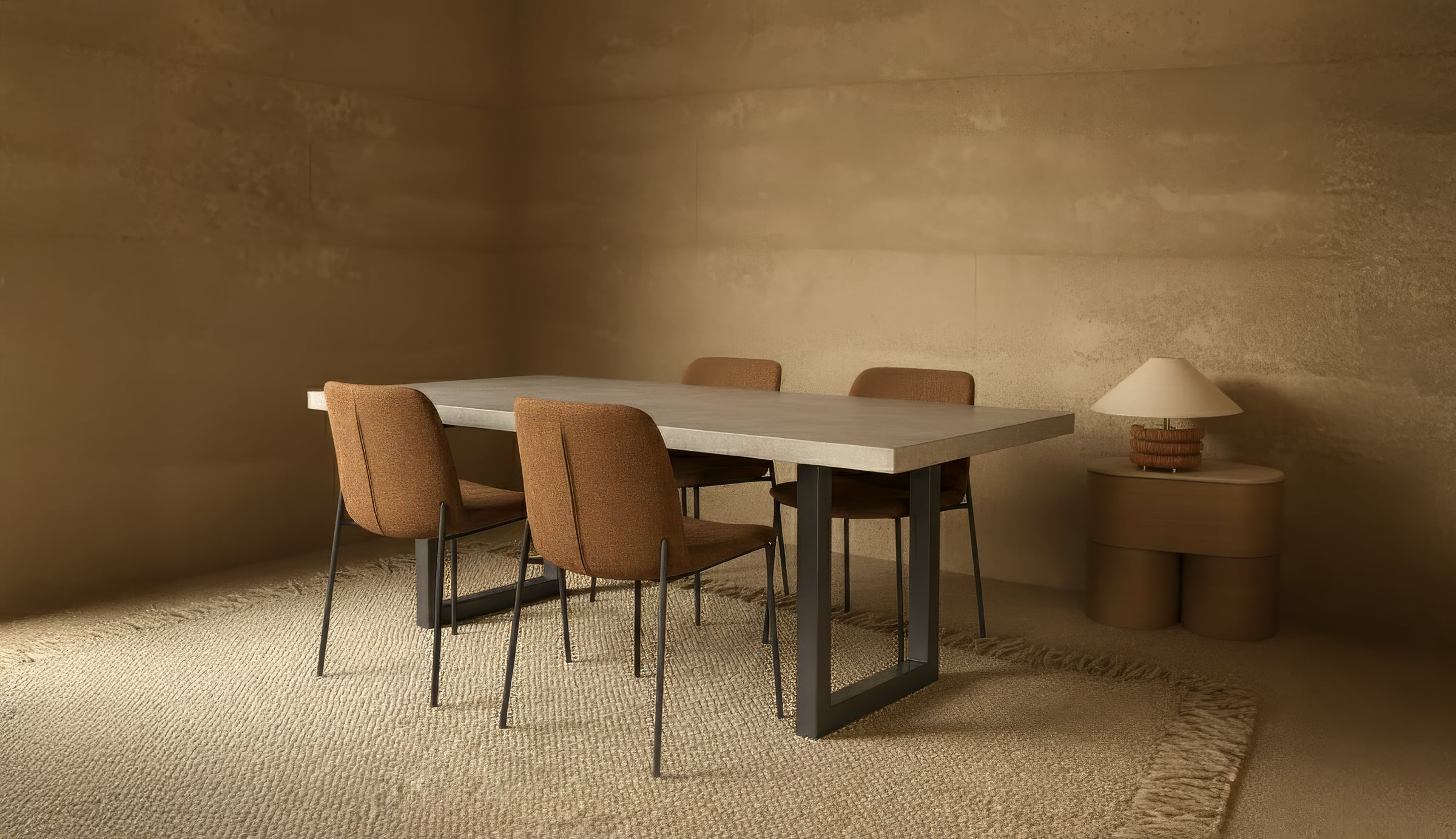
People who haven't seen a concrete table being made often picture a quick pour and a finished piece. The pour is the fastest part. Everything else — the mould, the cure, the finishing — takes weeks. Here's the actual sequence.
Mould-making
Every cast starts with a mould. For standard-range pieces, the mould is reused across batches. For custom commissions, we build the mould in plywood and steel from your shop drawings. Bespoke moulds typically take three to five days, including any cut-outs for BBQ grills or pizza-oven landings.
The mould is more than a container. The interior surface determines the surface texture of the cast. We finish the mould interior to match the requested finish — honed, semi-polished, or polished — before the pour.
Composition and pigment batching
The composition is silica-free, glass-fibre reinforced, and roughly four times the flexural strength of standard concrete at a third the section thickness. Pigments are studio-batched into the composition before the pour, so colour runs the full depth of the cast.
For colour-critical work we cast a sample tile in the chosen pigment and finish first, post it to the client for sign-off, and only batch the main pour after approval.
Cast
The cast itself takes a working day. We mix the composition, pour it into the mould in stages, vibrate to release trapped air, and screed the back. The piece sets overnight; we demould the following morning and inspect for any surface defects before moving to cure.
Cure
Twenty-eight days. The composition gains roughly half its final strength in the first week and the balance over the remaining twenty-one. Cure happens in a humidity-controlled rack in the studio — pieces stacked vertically, separated by foam isolators, kept at consistent temperature.
The cure is the most important step in the process. Pieces dispatched before the full cure mark, crack, or fail at the seal in the first year. We don't shortcut it.
Finishing
Once cured, the piece moves to the finishing bench. Honed finish takes a day per face; semi-polished, two days; polished, three to four. Edge profiles are hand-finished — the eased edge most clients prefer is shaped by hand, not routed.
Sealing
Two coats of the satin food-safe studio seal, built to one studio standard for indoor and outdoor use. The seal resists red wine for six hours and sets under controlled humidity for forty-eight hours before packing.
Delivery
Pieces are crated for transit, delivered to the address on the order, and site-placed in the metro area: positioned, levelled, and inspected before we leave. The care guide ships with every piece.