



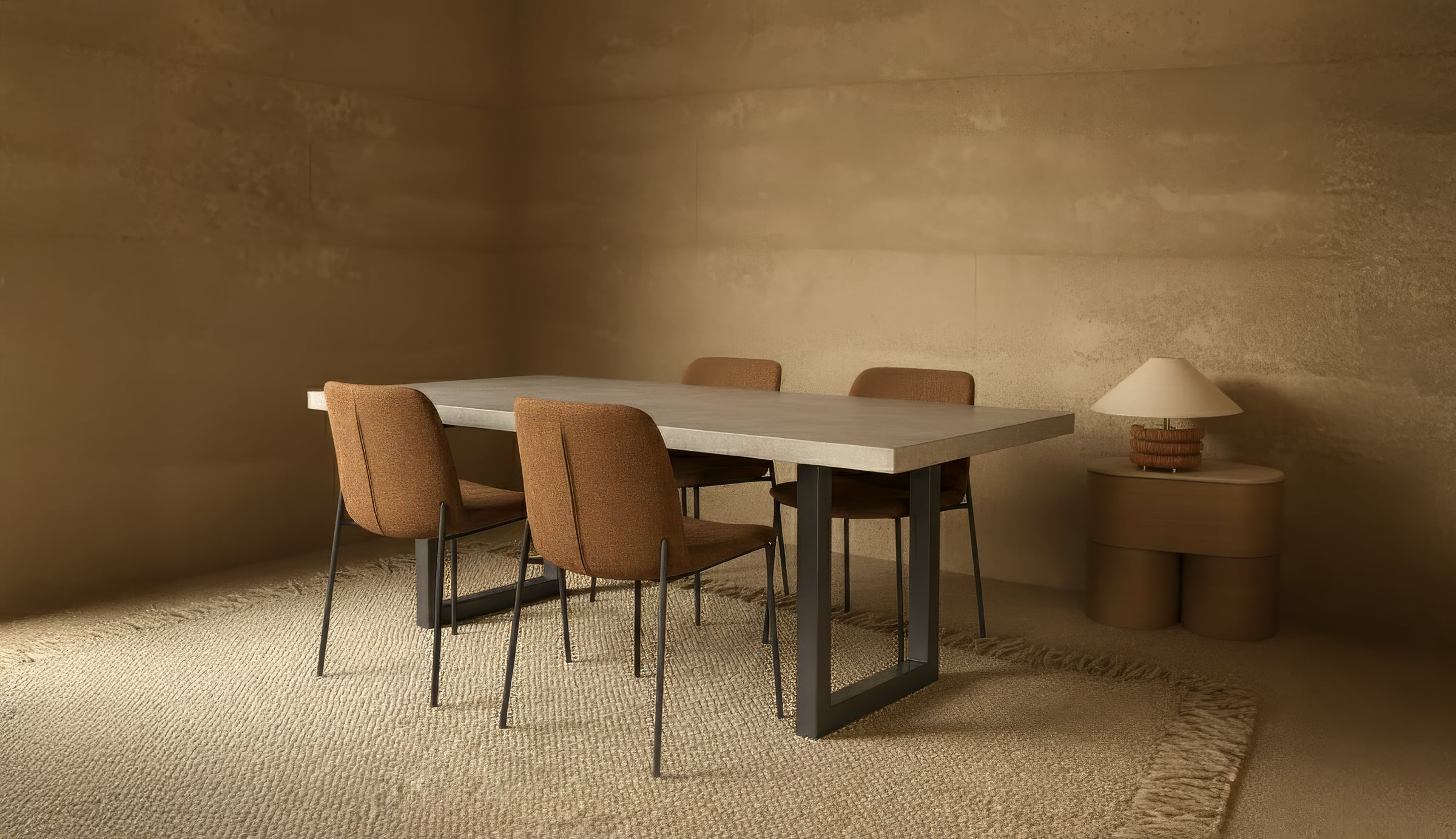
It's the question we're asked most often. Short answer: properly-cast architectural concrete tables don't crack. The longer answer is more useful, because it tells you what to look for when you're commissioning a piece.
Why structural cracking is rare
Two things prevent it. First, the composition. Our composition is glass-fibre reinforced — tens of thousands of fine fibres distributed through the cast act as crack-arrest reinforcement. Where standard concrete is brittle in tension, GFRC has roughly four times the flexural strength and is substantially more ductile. A blow that would crack standard concrete simply marks the surface of GFRC.
Second, the cure. Our cure runs twenty-eight days, and a piece that ships before the cure is complete is more vulnerable to cracking under handling stress. We don't shortcut the cure. Pieces leave the studio at full design strength.
When cracks happen
The cracks we've seen across a decade of casting fall into three categories.
First: under-cured concrete. A piece that leaves the bench before its cure is finished is vulnerable in the first year of use, whoever cast it.
Second: edge damage from impact. A heavy chair leg dragged against an edge, a vacuum head striking a corner, a piece dropped during a house move — these can chip an edge. They don't cause structural cracks; they cause repairable cosmetic damage.
Third: thermal shock at temperature extremes. A piece left outside in a freezing winter (un-rated for outdoor use), or repeatedly exposed to a torch flame, can develop hairline surface cracks. Outdoor-rated compositions handle Australian winters; indoor-rated compositions don't want to live outside.
What to look for when commissioning
Ask the studio about cure. How long does a piece cure, where does it cure, and what conditions is it held in? Ours runs twenty-eight days in a humidity-controlled rack. A maker who cures to a set schedule will tell you what that schedule is and why.
Ask about reinforcement. Glass-fibre, steel mesh, or both. Unreinforced cast concrete in a 40 mm dining table top is not the same product as our composition.
Ask about composition. Silica-free for the safety of the studio team and the seal performance. Roughly four times the flexural strength of standard concrete for furniture-grade strength.
Ask about consumer protection. In Australia your protection comes through the Australian Consumer Law: ask the maker how they stand behind a manufacturing fault, what happens if a piece arrives damaged, and how they'll service surface wear over the long run.